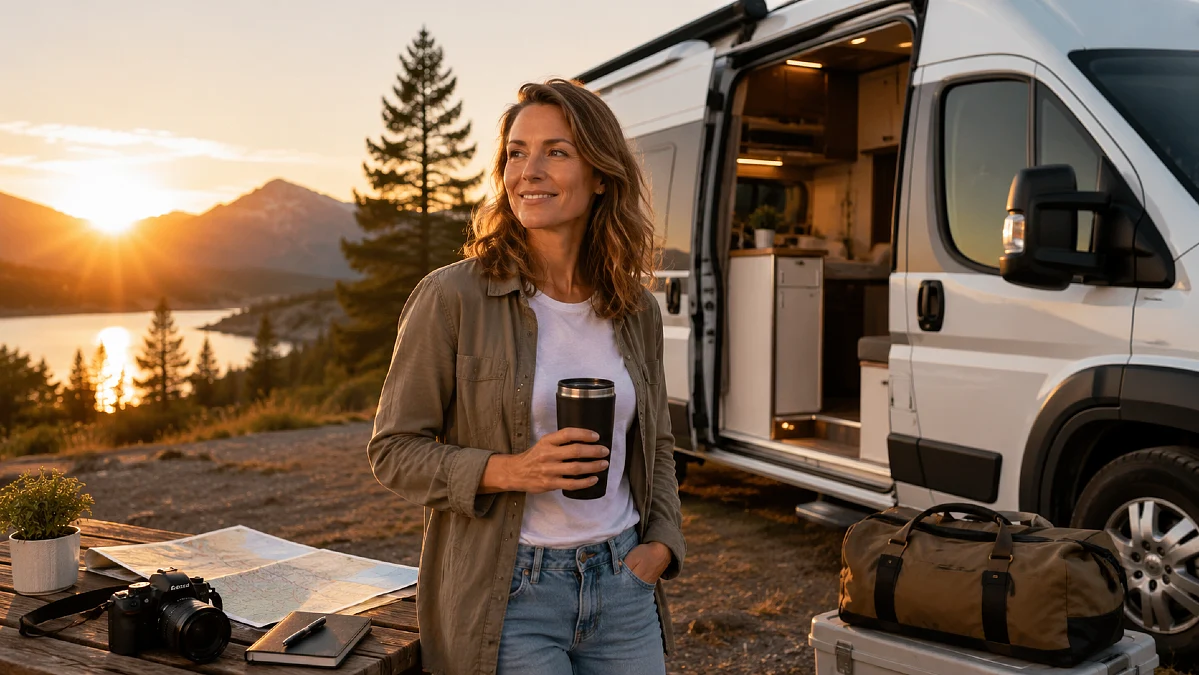
Instagram shows perfect sunsets by a mountain lake. The reality involves tight budgets, dirty maintenance, and intense daily planning. Transitioning to full time RV living feels overwhelming right now.
You see hidden costs everywhere. You find outdated advice that no longer works. You need a clear path forward. This guide will help you plan your first year of full time RV living with real numbers.
We built a realistic, data backed roadmap for 2026. It covers budgets, internet connectivity, mail forwarding, and smart route planning.
Calculating Your Full Time RV Living Costs in 2026

Many think living in a camper is basically free. It is definitely not. A realistic RV living budget ranges from $2,500 to $4,500 per month in 2026. This depends heavily on your travel speed and campsite choices.
Renting private campground spaces has become expensive. Places like KOA now charge $40 to $80 or more per night.
Where exactly does all this money go? Fuel and insurance take up a huge chunk. Full timer insurance costs recently went up 22 percent.
Expect to pay about $150 to $300 a month. Luckily, a recent drop in gas prices helps. Gas averages around $3.15 per gallon in 2025 and 2026. This acts as a great buffer for other rising expenses.
How do you handle unexpected repairs? You must plan a $3,000 to $5,000 annual emergency maintenance fund. Experts recommend setting aside 10 to 15 percent of the purchase price every year for maintenance. RV shop labor rates easily top $120 per hour.
Budget Trap: Do not forget utility costs. Your monthly utility bill can vary by $50 to $200. This depends entirely on your solar capabilities and local weather.
Let us look at a typical $3,000 monthly breakdown for full time RV living costs 2026.
| Expense Category | Monthly Estimate |
| Campsites | $900 |
| Food and Groceries | $600 |
| Fuel | $500 |
| Insurance and Health | $400 |
| Maintenance Savings | $350 |
| Internet and Fun | $250 |
Action Step: Download a simple monthly spreadsheet right now and plug in your current income.
Downsizing and Transitioning to Full Time RV Living
People think they can pack their entire house into a trailer. You simply cannot do that. Weight limits and tiny cabinets make extreme downsizing mandatory.
Millennials and Gen Z now make up 32 and 35 percent of highest purchase consideration for these rigs. They are leading the charge in minimal living.
How do you get rid of a lifetime of stuff? You need a strict 6 month timeline.
- Month 1 to 2: Sort everything into keep, sell, and donate piles.
- Month 3 to 4: Host garage sales and list expensive items online.
- Month 5: Choose between keeping a small home base or selling everything.
- Month 6: Store your absolute favorite sentimental items and pack the rig.
What about all those important papers? You must do a massive digital decluttering. Scan all your important documents and old family photos to a cloud drive. Physical paper adds heavy weight and takes up valuable space.
Pro Tip: Use the “one in, one out” rule. If you buy a new sweater, an old sweater must go to a thrift store. This manages your weight capacities.
Transitioning to full time RV living requires letting go of material goods.
Managing Your Domicile Mail and Insurance

Beginners think they can just use a relative’s address for everything. That causes massive legal headaches. You need a proper RV domicile. This is your legal residence for taxes, voting, and vehicle registration.
Which states are best for nomads? Texas, Florida, and South Dakota are the top choices for 2026. These states have no state income tax. They also make it very easy for full timers to register vehicles.
Once your state residency is settled, how do you actually get your Amazon packages and tax documents? You must set up a professional mail forwarding service.
Companies like Escapees RV Club or Dakota Post give you a real street address. They receive your mail, scan the envelopes, and forward the physical copies wherever you park.
What about protecting your home on wheels? You need specialized insurance. Standard policies do not cover people living inside the rig every day.
Full time policies offer liability coverage similar to a standard homeowner policy. This is crucial if someone gets hurt inside your rig.
| Top Domicile State | Best Feature | Mail Service Example |
| South Dakota | Lowest fees | Dakota Post |
| Texas | Great health plans | Escapees RV Club |
| Florida | Warm winter base | St. Brendan’s Isle |
Your goal is to make full time RV living legally stress free.
Staying Connected: Internet and Remote Work
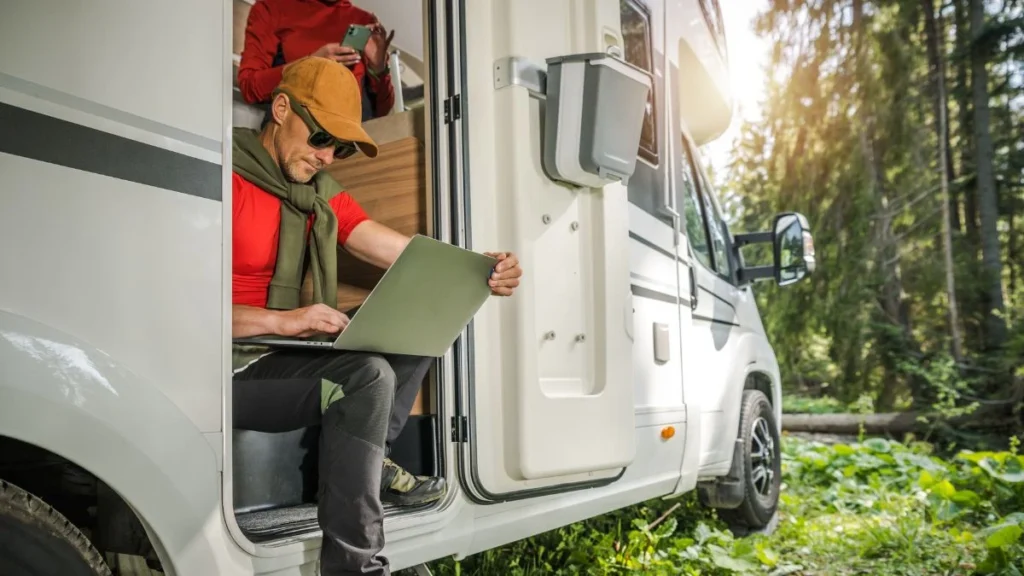
Most beginners assume campground Wi Fi will be enough for their Zoom meetings. It won’t. Relying solely on park internet is a massive mistake. The connection usually drops right when you need it most.
How do you guarantee a strong signal for work? You absolutely need a dual network setup. This means combining satellite internet with cellular data. Using Starlink as your primary connection is the smartest move for 2026. Starlink remains the dominant force for remote workers.
What are the current hardware options? The ultra portable Starlink Mini and the standard Roam plans are incredible. They routinely offer speeds of 300 Mbps or more. The Roam plans start at $55 a month for 100GB of data. You can also get unlimited data for $175 a month.
Having an ironclad RV internet setup is the only way to sustain remote work in an RV.
Route Planning and the Best RV Living Apps

You might think you can just drive until you find a nice spot to sleep. That is a quick way to get stranded. Proper RV route planning keeps you safe and protects your budget.
How much driving is too much? You should follow the 330 Rule. Drive no more than 330 miles a day, or stop driving by 3:30 PM. This keeps you rested and lets you set up camp in the daylight.
How do you afford sleeping somewhere every night? You must blend boondocking with paid private parks. Boondocking means camping on free public land without hookups. This balances the budget when park prices get too high.
What tools make this easier? You need the best RV living apps on your phone.
| App Name | Main Purpose | Cost |
| RV LIFE Trip Wizard | Safe routing away from low bridges | Paid yearly |
| iOverlander 2 | Finding free off grid spots | Free base version |
| Harvest Hosts | Unique overnight stays at farms | Paid yearly |
Spotlight iOverlander 2 for off grid spots. Use RV LIFE Trip Wizard for safe routing to avoid low clearance bridges. Try Harvest Hosts for unique overnight stays at farms and wineries.
Managing Healthcare and Prescriptions on the Road

Many new travelers forget about getting sick on the road. Finding a good doctor away from your home state causes major stress. You might wonder how to handle prescriptions and routine checkups. You need a solid health care plan before you leave.
First, look into national health insurance networks. The Affordable Care Act offers specific plans that cover you nationwide. You must verify that your plan works outside your domicile state.
Next, embrace telehealth services. Virtual doctors can handle minor illnesses quickly. They can also send medicine directly to local pharmacies near your campsite.
Finally, use large pharmacy chains for your regular medicine. Stores like Walgreens or CVS let you transfer prescriptions easily from state to state. This prevents you from running out of important daily medications.
| Care Type | Best Option | Expected Cost |
| Minor Illness | Telehealth Visit | $40 to $75 |
| Daily Medicine | National Pharmacy Chain | Varies by drug |
| Urgent Injury | Local Urgent Care | $100 to $200 |
You have to prioritize your physical health when living out of a vehicle.
Action Step: Call your current health insurance provider today to ask about nationwide coverage options.
Building a Community to Beat Road Loneliness

Social media makes camper life look like a constant party. The truth is that life on the highway gets very lonely. You will miss your friends and your old local community. How do you find your people out here? You have to build a new network from scratch.
Join dedicated clubs like Xscapers or Fulltime Families. These groups host huge rallies where you can meet hundreds of other travelers. You will find people who share your exact interests and struggles.
Look for volunteer camp hosting jobs. This gives you a free place to stay and a built in neighborhood for a few months. You get to interact with new campers every single day.
Make an effort to talk to your neighbors at private campgrounds. A simple greeting outside your rig often leads to great friendships and shared campfires.